Everything in Amsterdam moves in cycles—bikes, water, stories… and second chances.
Amsterdam might rhyme with hamsterdom, but it has nothing to do with fuzzy pets—unless you count the millions of wheels spinning in a constant cycle of existence.
I was in Amsterdam last week and seeing people on two wheels everywhere was not a surprise. Every big city has a signature lifestyle; cycling is the thing in Amsterdam—rain or shine; the Dutch saying that “you aren’t made of sugar”(je bent niet van suiker). According to the Netherlands Institute for Transport Policy Analysis, over a quarter of all journeys nationwide are by bike, but in Amsterdam, that number spikes, with nearly 500,000 cyclists hitting the road daily. They are not just cyclists; they are ninjas coming from every angle.
To experience the city fully, you need to experience that thing—like fast-walking in New York and shuttle (dolmuş) hopping in Istanbul.
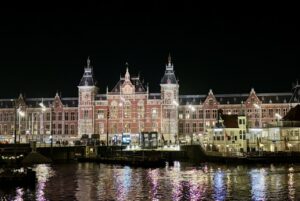
The other fascinating thing about Amsterdam was the city layout, which allows people to experience water and greenery in a city where history is carefully preserved. The “Grachtengordel” (Canal Belt) was a massive urban project started in 1612. To build on the swampy land, they didn’t just dig canals; they drove millions of wooden piles (mostly spruce) through the soft mud into the sandy ground below to support the houses. People flocked into the city, merchants moved goods directly through the canals into their warehouses, and the economy bloomed.
Many of those “original” exteriors are protected by strict UNESCO heritage rules, but the interiors are often high-tech, minimalist spaces—much like the “adaptive reuse” seen in Manhattan’s West Village or SoHo, where brownstone buildings still stand against time and ever-changing fashion. Even the NYC “stoop” (a small set of stairs leading to a raised first floor) is a direct gift from Dutch architecture. The word “Stoop” actually comes from the Dutch word stoep!
However, spotless windows are a thing in Amsterdam. For narrow townhouses, front and back windows are the only source of light, which the Dutch appreciate with spotless glass. No curtains, no blinds; it means there is nothing to hide. There is a cultural term for this in the Netherlands: Bescheidenheid (modesty/humility) mixed with a historical Calvinist idea that if you have nothing to hide, you don’t need curtains.
The “narrowness” of Amsterdam houses was actually a tax-dodge—back then, you were taxed on the width of your frontage, which is why they are so slim and tall (just like New York’s vertical ambition!). It is no surprise that Amsterdam reminded me of New York, as the original designers of New York were the Dutch and the city was first called New Amsterdam. Wall Street was named after the actual “Wall” the Dutch built to protect the settlement, and Broadway was originally the Brede Weg (Broad Way).
New York wasn’t founded by a government, but by a corporation: The Dutch West India Company. They wanted the city to look like a mini-Amsterdam to make the merchants feel at home, which is why they prioritized canals and the narrow, gabled house style. While Manhattan doesn’t have canals today, it was originally designed to have them. Broad Street was once a mirrored version of Amsterdam’s Heere Gracht, and Canal Street actually hides a buried waterway beneath its busy traffic. The Dutch brought their water-centric DNA to New York; the British simply paved over it for hygiene reasons.
Another thing about Amsterdam houses: they are so narrow that people need to get their furniture in through the windows, so every house has a hook at the top of the gables. The staircases are so death-defyingly steep and skinny that I had an OMG moment when I had to move my suitcase two stories up to get to the Airbnb for my stay. Moving furniture? Forget about it.
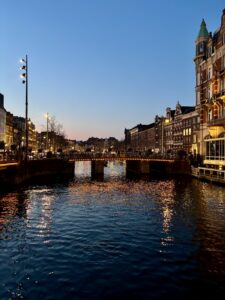
These old houses are a pleasing sight above and on the canal through their dancing reflections on the water. Wait—they don’t even need reflections to dance! These houses lean forward or sideways and have earned the nickname “Dancing Houses.” Because the wooden piles are centuries old, some have rotted or shifted in the mud. Many were actually built to lean forward (called op de vlucht) so that when you used the hook and pulley to lift goods, they wouldn’t smash into the windows on the way up! Practical, right? You don’t want to smash the window on the first floor when you pull your newly bought vintage couch up to the second floor.
Another fun fact: between 12,000 and 15,000 bicycles end up in the canals every single year. There is actually a specialized boat with a giant “claw” called a grachtenfisser (canal fisherman) that patrols the waters just to catch rogue bikes. It’s a literal continuation of existence—even the bikes end up in water, and the ninjas simply get new bikes to continue cycling.
Walking the Amsterdam streets along the canals was like visiting a fairy tale. Next to the latest fashion, vintage stores offered vintage pieces—recycling fashion as an antidote to high consumerism. By pointing out the cost of producing new clothes and promoting reuse, they offer a way to build your own style from what is already available—which wasn’t a surprise to me either.
But what was a surprise was seeing parcels in bins along the vintage stores. First, I thought people were sending their clothes to the stores to sell, and the stores were unpacking or sorting them out by the windows for transparency or entertainment, who knows why.
I told myself, “If that’s what these parcels are about—wow.”
Then another thought: maybe these were online orders. Everything is online these days.
That many? Everywhere?
I passed the vintage stores with these two possibilities in my head until I walked into one in Jordaan and saw the sign:
Any item in this bin: €3.
The other: €4.
The third—mystery parcels priced by weight.
Apparently, those parcels are for sale!
Nobody knows what they have. It is like a gamble. You assess them by holding or shaking before buying. That is it. And then open them. Ta-daa. The rumor is that some people have found really expensive items this way.
This is very much a thing in the Netherlands. This “mystery parcel” business often involves companies like King Colis or local resellers who buy undeliverable packages from giants like Amazon, PostNL, or DHL by the ton. These pop-ups and vintage shelf-spaces usually sell parcels for a set price per 100 grams (often around €1.99 to €2.79). While most people find “boring” stuff like phone cases or cables, documented rumors of people finding luxury watches or high-end electronics fuel the gambling excitement. Recent reports from Dutch News (2026) mention that nearly one million packages go missing or remain unclaimed in the Netherlands each year, feeding this secondary “mystery box” market.

This isn’t just a gamble; it’s becoming a recognized part of the “Circular Economy” in the Netherlands. Circular. Again. Instead of these parcels being incinerated or sent to landfills, they are given a second life. It fits perfectly with the idea of being an antidote to high consumerism.
Even though for the couple who explained this to me at the store this was not a surprise, they shared my excitement while shaking and guessing parcels hovering over a giant bin. I joined them—well, why not?—and purchased two parcels.
The second chance came back to me at night again. I went to Mezrab for a storytelling event (first I went to The Other Mezrab, which is really the other Mezrab by mistake!). The theme of the event was “The Second Chance.”
After a story by a woman from Iran—about her childhood and her longing for a second chance—I started a conversation with a young woman sitting next to me, Mavi. “Mavi means…blue in Turkish.” She already knew. I told her that I am in my home country for the second round. She was quick to link “You mean second chance.”
Now, I am back home. My two mystery boxes are still wrapped in their plastic bags, waiting. If waiting is something that can be learned, they’ve mastered it. They’ve waited in grey warehouses, they’ve waited for recipients who never came, and they’ve waited in bins for someone to pick them up. Now they’re waiting for me to decide what comes next.Once I open them, I’ll decide if I’m the one to finally give them their second chance.