Why do most authors publish books?
Not for fame.
Not for money.
They publish books to be heard.
It may sound like a simple question, but the answer is deeply human. Authors publish books to find the readers who will resonate with their stories—stories that have grown too deep and too rich to remain contained within personal life. Eventually, they take shape on paper and ask to be shared.
There may be other motivations too: recognition, appreciation, even a little fame. But without the desire to connect with someone beyond ourselves, it is difficult to sustain the discipline required to write a book.
Writing a book is a bit like giving life.
There is gestation, pregnancy, birth—and then the long process of caring for it until it finds its own place in the world.
I know this from experience.
I also know there is a delicate balance in this process. To write honestly, an author must allow themselves to be vulnerable. And vulnerability is deeply human.
The desire to build a powerful story.
The desire to be read.
The desire to reach others.
All human qualities.
And like many human qualities, they can also be exploited.
Before I launched my latest book, The Shared Pulse, I started receiving emails from book club organizers.
The first message came from Singapore. The sender praised my book and my writing style and asked for permission to feature it in his book club.
I was surprised.
How did he even find the book? It had only been available on the platform for a couple of days, and the official launch had not even happened yet.
Working in technology professionally, my instinct was to be cautious. I asked for a link to the book club. I was curious as well.
He replied politely and provided everything I asked for, along with a list of materials I should send for the feature.
After a few exchanges, the real request arrived. A fee to feature my book.
That was the moment the story changed.
Then more messages arrived.
From different countries.
Different “book clubs.”
Very similar praise.
Apparently I had not yet reached my readers—but I had definitely reached something else.
The messages were strikingly similar: glowing compliments, repeated keywords, enthusiastic tone… yet somehow robotic.
Once I recognized the pattern, I stopped responding. Why bother replying to a machine? I would not hurt its feelings by staying silent.
Even though it felt impolite not to reply—not even with a simple thank you—it seemed like the only way to keep my inbox from filling up.
But the messages kept coming.
Some didn’t ask for a fee to feature the book. Instead, they suggested that my book needed a promotional video and conveniently offered a contact who could produce one.
A promotional video… for a book club?
Seriously?
At the same time, I began receiving waves of promotion offers, all written in nearly identical language.
The experience reminded me of something important.
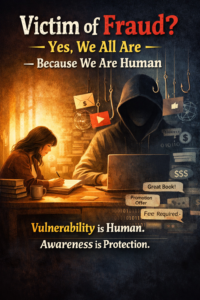
We all have vulnerabilities.
We all have sweet spots.
Because we are human.
Sometimes our desire to be seen, to be appreciated, or to share something meaningful can cloud our logical thinking. We may drift away from our center when making decisions.
Fraudsters know this.
They don’t only target romance scams or promises of easy money. They also target authors—people who care deeply about their work and want their voices to be heard.
Publishing, it turns out, has its own ecosystem of scams.
So if you are an author, be aware.
And remember:
Fraud works because we are human.
We are vulnerable.
But awareness is human too.
And we are capable of holding both.