Bozcaada
The Crow That Came Along
“There are crows, lots of crows here. Their cries scare me. Their cries remind me why a group of crows is called a ‘murder.’”
Pete wrote that in his letter to Cate. She never read these lines. (From Jumping on the Drips)
I had been to the island many times but had not seen so many crows before.
In the last week of October, the island was left to its blues of wind and rain. Few tourists were walking in and out of the ferry station. The coffee shop keepers were regretting that they had not added more songs to their playlists. They would soon long for a fresh memory to be triggered by an unexpected song. The meyhane keepers were cleaning the accumulated dust from the whitewashed wooden tables, already longing for the summer ahead, when they would wipe away raki stains instead.
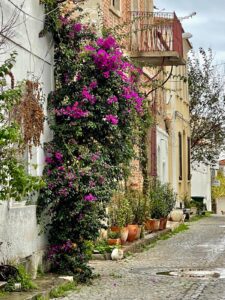
Ela and I were strolling along the narrow cobblestone streets towards the windmills, passing colorful, postcard-beautiful houses and purple flowers sprouting from the small patches of earth left between the stones. “Seagulls never leave the castle unattended,” I said to myself, and heard another cry of crows. I looked up and saw lots of them. One landed in front of us. Ela said, “Mummy, look! Their eyes are greyish blue.”
“Blue Crow,” I was told, is the island’s symbol. Mahmut Abi had suggested that I use the terrace of the neighboring establishment, called Blue Crow, for my yoga class during the retreat because of the rain. And then, crows were everywhere. Was it selective perception, or had people been hiding crows from me during my earlier visits?
Melahi and I were ready for our fourth retreat on the island at Shiraz Bağevleri, after a long drive from Istanbul and a ferry ride on a grey, drizzling day. A long ride—that was what I needed, what we needed, to leave our routines behind, disconnect, and create space for new experiences.
I had been preparing a program to face and embrace what I would call our demons—or, in more acceptable terms, our archetypes—supported by nature, yoga, meditation, companionship, food, love, and acceptance, in the welcoming place hosted by Mahmut Abi and Mehmet. Melahi was in charge of the food. Triple-M comfort.

I was ready to open up the box of archetypes for the participants, who were and had been my dear friends. We had invited our teenage children to join this experience as well, but I was not sure which of my own archetypes would come with me to the island. I needed a long ride to leave some behind while greeting and embracing others.
An accident at the beginning of the drive picked one for me. An angry driver waiting to take my spot at the gas station called forth one of my archetypes when he hit my car from behind. He shouted that we had to hurry and leave the gas station because he was waiting for us to free the pump. We were checking the map when we were startled by a force from behind. My interpretation was that I had not done what he had told me to do, and now he was hitting my car, forcing me to obey. I stormed out of the car. I put on my protector archetype to protect my daughter and friend in the car, as well as myself. I yelled at him. He said that he thought I was pressing the accelerator, when I was actually pressing the brake. Then, everything from my Istanbul routine was left behind.
When we arrived at the ferry station to leave the mainland behind, a gift was waiting for us: a burning sky, a setting sun, and not one but two rainbows.
It was late when we arrived on the island. In the morning, I woke up to the songs of birds. I opened the window overlooking the vineyard and the sea. The air carried the smell of petrichor. I remembered Pete’s writing about petrichor to Cate. How beautiful the smell of the earth could be!
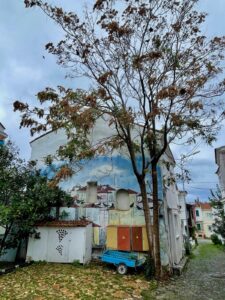
I wanted to show Ela the island before our guests arrived. The castle, the windmills, the Greek Quarter, and the ferry terminal all found their places beautifully in the view from the hill. Then came the cries of crows. Bozcaada has a long history of different eras, cultures, and religions. Even though the island is separated from the mainland, the influences of the powers that ruled it were embodied here.
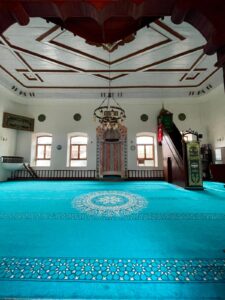
The Meryem Ana Kilisesi (Church of the Virgin Mary), built in 1869 in the Greek Quarter, faced Köprülü Mehmet Paşa Camii, built in 1655.
Together, these buildings are reminders that Bozcaada’s history is not a single, uninterrupted story, but one shaped by different communities, political powers, and religious traditions.
These must be the archetypes Bozcaada chose to embody, carrying them through the centuries and allowing locals and visitors to interact with them and find their own reflections in them.
And crows… They can live for years. Intelligent, adaptable, and deeply social, they are also birds whose dark plumage and cries have long associated them with death and foreboding. They seem to carry contradictions within themselves: the solitary observer and the member of a murder, the harbinger of death and a survivor, a creature of the familiar and the unknown. Perhaps they embody multiple archetypes in one.
The stores in the island center mostly sold olive oil, wine, and cookies. Eighty percent of them were already closed for the season. For only a few months of the year, the island comes fully alive. Then come the blues of wind, cold, and rain, with an ever-changing, beautiful landscape.
The bays and beaches were still pristine, clean, and inviting. A couple of days later, the wind slowed down and the rain stopped. I dipped my toes into the sea for the first time. My swimsuit was hidden underneath my beach dress and a winter coat. Unsure what to do, I lingered for a while, and then the sea called. I slowly removed my layers and immersed myself in the water.
Melahi asked on the way back, “Why do you do that?” I know the answer now. These gatherings, these retreats, are real. Participants encounter their authentic selves. How can you wear a mask when you are together all the time in nature, connected to yourself through the tools we enjoy exploring? It is real, and I am nourished by these precious moments.
Our last circle ended with a reminder: Notice your exhale. Every exhale is an ending, a pause before a new beginning.
I have been a teacher since the first retreat here, but I am also a mother, friend, protector, dreamer, warrior, child… now, too. I feel full.
Last night, we were all dancing, drinking, and laughing. The children—Peri, Deniz, Asya, and Ela—were playing cards with Gaye, their faces painted. The hand-decorated masks from the earlier self-expression session were still around. I watched Barış and Gülben dancing together, Metehan cracking jokes with Mahmut Ali and Fırat, and Demet and Elif deep in conversation while Demet sorted out the playlist. Melahi brought dessert, Mahmut Abi cared for Sushi, and Mehmet poured tea into tiny tea cups. Oksan watched the night from the windowsill. Lady caressed herself on her favorite bed. Laughter came from every corner. Some were outside enjoying the hammock. It felt good.
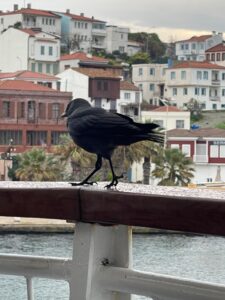
On the ferry deck on the way back home, Fırat showed me the crow sharing the same view I was looking at. Instead of seagulls, a crow was accompanying us.
“Strange,” I thought.