
What Does It Mean to Be Healthy?
A man went to a Zen master and announced, “I want to become perfectly healthy.”
The master nodded. “Excellent. What are you doing about it?”
“I eat organic food, meditate for an hour every morning, exercise five days a week, sleep eight hours, and avoid stress.”
“Wonderful,” said the master. “And how are your relationships?”
The man frowned. “My family says I’m unbearable. My friends have stopped inviting me to dinner because I lecture them about sugar. My wife says I haven’t listened to a word she’s said in three years. My kids don’t even notice I’m home.”
The master poured him some tea.
“And your work?”
“I’m busy. I work nonstop and still can’t get everything done.”
“I see,” said the master.
The man leaned forward. “So, Master, what else must I do to become healthy?”
The master smiled. “Perhaps you could start by having dinner with your wife, letting her finish a sentence, and having some fun with your kids.”
The man looked horrified. “But what about my meditation?”
“Try listening,” said the master. “It might be the first time you’ve meditated with your eyes open.”
Today is World Mental Health Day, a reminder of how important it is to have the capacity to respond to life.
Mental health is more than the absence of mental disorders. It is also about how we experience our emotions, relate to others, adapt to change, and navigate life’s uncertainties.
Here are five capacities that can help us understand mental well-being:
- Emotional flexibility: Being able to experience emotions without being completely controlled by them. You can feel anger without becoming anger, or sadness without believing that sadness is all you are.
- Mental flexibility: Being able to question your assumptions, learn from experience, tolerate uncertainty, and change your mind when necessary.
- Relational capacity: Being able to connect with others while maintaining boundaries, ask for help, experience intimacy, and repair relationships when things go wrong.
- Adaptability: Being able to respond to change without losing yourself completely. This includes knowing when to persevere, when to rest, and when to let something go.
- A sense of agency: Being able to make choices, recognize your needs, and influence the direction of your life, even when you cannot control every circumstance.
Interestingly, in Turkish, World Mental Health Day is called Dünya Ruh Sağlığı Günü. The word ruh can mean soul or spirit, as well as psyche.
I don’t know exactly why this expression became the conventional translation. Perhaps there are linguistic, historical, or cultural reasons behind it. But it made me curious about what happens when we think of mental health through the lens of soul health.
What if this expression invites us to look beyond how our minds function and consider how we inhabit our inner lives?
Soul health adds another layer to the meaning of the day.
Authenticity
Am I living in a way that feels true to me, or am I constantly performing a version of myself for others?
Meaning: Does my life contain things that feel worthwhile beyond productivity, achievement, and external recognition?
Connection: Do I feel connected to other people, the natural world, my community, or something larger than myself?
Openness: Can I remain curious about life, allow myself to change, and make room for parts of myself I have previously excluded?
Inner coherence: Do my choices, values, feelings, and actions have some relationship with one another, even when they conflict?
These questions bring me back to the multidimensional nature of health.
Health is not just about the body, the mind, or our relationships. It can also include our sense of meaning, authenticity, and connection to something beyond ourselves.
Being healthy is not simply the absence of disease. It is also about having the capacity and flexibility to respond to life without being completely controlled by our circumstances, thoughts, or emotions. It is about having the freedom to choose how we respond, whenever that freedom is available to us.
Consider this: Is a person in excellent physical condition but disconnected from themselves and their community necessarily healthier than someone living with a chronic illness who remains engaged with life, connected to others, and able to find meaning?
Perhaps health cannot be measured along a single dimension.
There may be times when we need to focus on one aspect of our lives more than others. We may need to prioritize our physical recovery, our emotional well-being, our relationships, or our search for meaning. But neglecting other aspects of ourselves for too long can leave important needs unmet and create a sense of disconnection.
Maybe health is not about choosing one dimension over another, but learning to recognize what needs our attention at different moments.
It is about responding consciously to life and caring for ourselves physically, mentally, socially, and spiritually, finding our way back toward balance again and again.
The goal is not to remain in balance all the time. It is to remain flexible enough to find our way back.
Perhaps that is what being healthy means: not being perfectly balanced, but being able to listen, adjust, reconnect, and begin again.
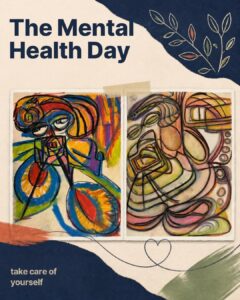
P.S. The drawings on the poster tell the same story in two different ways. Here’s a question for you: Which one do you think I drew first?