
Can We Stay Close Enough to Care and Separate Enough to Respect?
Close enough to care.
Separate enough to respect.
Flexible enough to become something new together.
Shapes have boundaries. We, human beings, have bodies. We have space – physical and subtle, which separate us from each other and allow us to experience ourselves as distinct. Without them, perhaps all we would experience would be uninterrupted, borderless existence.
The experience of having my personal space invaded at 7 a.m. on a flight was not what I wanted. My seat neighbor seemed completely unaware of the invisible line where their seat ended and my space began. I expressed my discomfort, except for a minute or two, nothing changed.
I landed in Helsinki like a squashed tomato in a cheese sandwich, only to discover that my stay in this Northern city would bring me closer to the question that bothered me on the plane.

Finnish design struck me right away. I was familiar with the bold and colorful patterns of Marimekko, but I had never been surrounded by so many subtle patterns in one place without feeling overwhelmed.
Abstract leaves on the walls, flowers on furniture, trees painted one next to another on the ceiling, curves in the architecture forming waves, white spots on glass representing clouds—all seemed strangely harmonious.
The patterns could coexist.
The objects within them could claim their separation and, together, form something bigger.
A tree cannot make a forest. Trees together can.
A leaf in a pattern is an abstraction of a leaf. Once abstracted, it no longer needs to represent the real leaf. It can become a new object, independent of the thing it came from. And yet, when repeated, it becomes a pattern.
There was no story I needed to decipher. Just repetition. It was forming the story.
A rhythm.
Almost a reminder of infinity.
Perhaps this is also reflected in the aspects of Finnish social norms: the value placed on privacy, autonomy, and giving loved ones space—sometimes as an expression of respect, sometimes simply as a way of being.
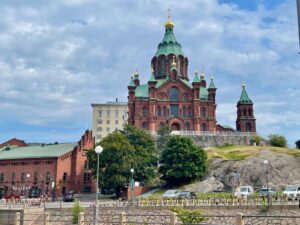
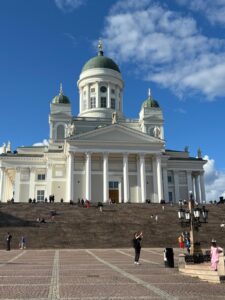
Even Helsinki seems to embody a kind of coexistence. Its history sits between East and West, and the city carries traces of both. Two cathedrals face each other across hills: Helsinki Cathedral on one side, Uspenski Cathedral on the other. Different forms, different histories, occupying their own spaces while allowing the other to exist.
The Aalto vase, the curves in the library, even the walls of our Airbnb seem to repeat this idea of continuity. Colors become reminders of summer after a long winter. Large windows open onto nature, turning the changing landscape into a constantly shifting artwork.

Simple lines of Moomin characters filled the souvenir shops, offering deceptively simple forms that held surprisingly complex worlds within them. Tove Jansson gave shape to the many-layered characters of Moominvalley through economical, expressive lines, simple enough to be instantly recognizable, yet rich enough to hold loneliness, curiosity, freedom, tenderness, and the contradictions of being human. Perhaps that is part of what made them so enduring: they were deeply rooted in Finnish imagination, yet never confined by it. They have been loved and treasured not only by Finns, but by generations of readers around the world.
I am not unfamiliar with simple lines or patterns, though.
Anatolian kilims and tablecloths are full of them. Their patterns often tell stories. Symbols carry meanings; motifs add layers to a narrative.
An individual becomes part of a family.
A family becomes part of a community.
A community becomes part of a city.
Each form creates something bigger by coming together with another.
So do relationships.
In many Anatolian families and communities, closeness can be a form of care. If you care, you ask questions. You offer advice. You check in. You stay in touch. People can feel responsible for maintaining closeness as a way of showing love.
The connection can remain even when you don’t see each other, but giving space out of respect and love does not necessarily come automatically.
The Finnish pattern seems to move differently.
Respect can mean giving space.
But perhaps there is a shadow on both sides.
Too much closeness can become intrusion. Care can become obligation. Connection can become a blurring of boundaries.
Too much distance can become isolation. Respect can make intimacy more difficult. Privacy can make asking for help feel harder.
So I began wondering:
Is it possible to merge these two patterns?Could we design patterns within patterns—sometimes allowing individual objects to stand alone, sometimes allowing them to overlap, sometimes bringing them close and sometimes letting them drift apart?
Could a relationship have the flexibility to move between these states without either becoming a threat?
Perhaps a healthy relationship is not a fixed pattern at all.Perhaps it is a pattern that can change.
Sometimes I need my own space.
Sometimes I need to come closer.
Sometimes you need to stand alone.
Sometimes I need to reach for you.
Maybe the beauty lies in knowing that the pattern can move either way.
Close enough to care.
Separate enough to respect.
Flexible enough to become something new together.

A fun line from the trip:My daughter’s reaction to a menu displayed outside of a restaurant: ‘Everything I don’t like made into a menu’What stayed with me:
The world of Moomin: https://www.moomin.com/en/characters/
The beautiful library. Bow to its architects. It is more than a library, it is an urban space where I felt so light, like being in the clouds, I took a nap on a comfortable chair: https://oodihelsinki.fi/en/what-is-oodi/
Oodi is one of nearly 40 libraries in the Helsinki City Library network that shares a collection of around 3.4 million books and other works.
Finns hold the world record for library use: Finns loan more books from libraries than any other nation on this planet.
Finnish patterns: https://www.marimekko.com/
Finnish designs and architecture: https://www.alvaraalto.fi/en/works/
Next time:
Finnish saunas
Forests